What we need right now is not more information. What we need is wisdom. Wisdom does not scream. It does not interrupt. It does not trend.
Wisdom waits. It speaks in the quiet voice beneath all the noise. It lives in places we have forgotten to look: the body, the breath, the heart, the soul.
Most of us are so caught up in keeping up with the latest trends in AI that we forget to stop and observe where we are. As individuals. As leaders. As families. As communities. As a planet. We are so busy tracking progress that we rarely ask what kind of progress it is or who we are becoming in the process.
THE QUIET CRISIS IN LEADERSHIP
Somewhere along the way, we handed over our intelligence to systems that reward speed over stillness. We built leadership cultures on control and performance. We called it progress. The more I listened, the clearer it became.
We are not leading. We are reacting.
Worse, we have become disconnected from the very intelligence that makes us human.
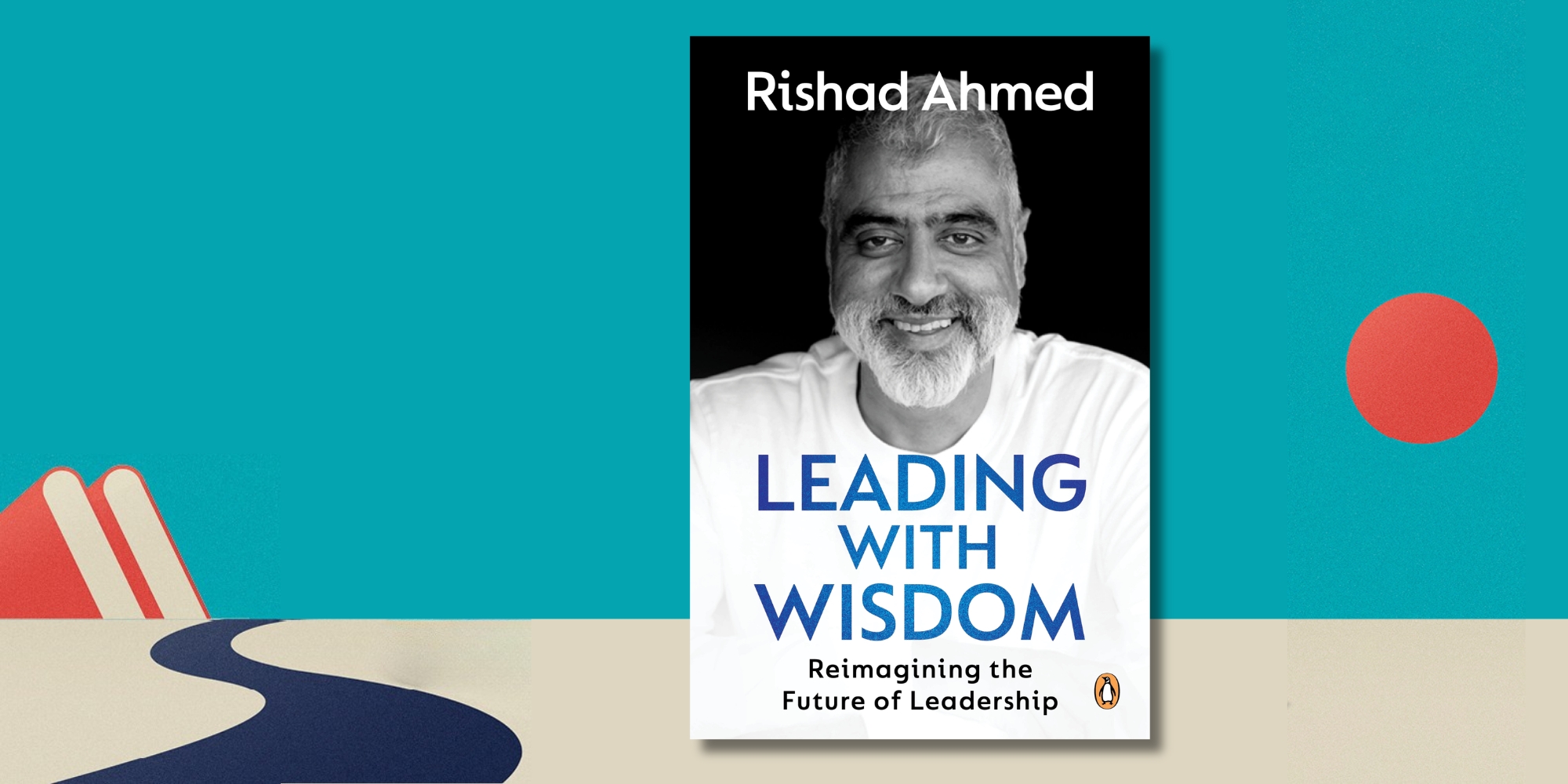
This book is a remembering rather than a method or model. It is for those who feel the fracture and are ready to lead from wholeness. It is for those who can no longer pretend the old game still makes sense. It is for those who are ready to walk a different path, not to escape the world but to serve it more truthfully.
A WORLD OUT OF RHYTHM
The rhythm of the world had changed. Without even realising it, most of us had started living at the speed of machines.
Managers began comparing human output to artificial efficiency, even if they didn’t say it out loud. People felt it. They began to rush even when there was no need to. To reply faster than their body wanted to. To show up harder than their spirit could sustain. Underneath it all was a quiet compromise. A cost paid in energy, in clarity, in truth, in peace within.
I saw people twist themselves to fit roles that hollowed them out. I saw professionals sacrifice their dignity to climb ladders that led nowhere. I saw moments where someone could have spoken the truth but didn’t because the game rewarded silence.
I began to understand something more deeply. We were never meant to live like this.
Our nervous systems are not digital. They are tribal. They evolved for intimacy. For presence. For story and silence. They are built to sense rhythm and resonance. They are not designed for continuous stimulation, hyperspeed communication or constant comparison.
THE CHALLENGE OF COMPLEXITY
This was already a crisis. Then came the exponential rise of AI.
When that moment landed, it felt like the ground shifted under me. It wasn’t a physical shift but an existential one. I knew something enormous had arrived, and I also knew most people would not know how to meet it. It wouldn’t be because they lacked intelligence but because they had already lost touch with the inner place that can orient one in the midst of complexity. That place had grown quiet, buried under tasks and timelines.
What’s needed now is not more leadership theory. It’s not more models or acronyms or frameworks dressed up in fresh packaging. What’s needed is presence. Stillness. Courage. A kind of listening that begins inside the body and heart, then moves outwards from there.
We don’t need more experts. We need elders.
We don’t need better marketing. We need deeper meaning.
This book is not an answer. It is a compass. It is not a new way. It is a remembered one.
STEWARDSHIP AND COHERENCE
Real leadership, I believe, is stewardship. It’s not just about personal success; it’s about taking responsibility for the living systems that sustain us: your teams, your organisation and the planet we share.
As you read on, you might notice how varied and interconnected the ideas I explore are. You might wonder, ‘Why include all these topics in a leadership book?’ That question hints at a fracture we need to heal. We’ve been conditioned to keep certain things separate – spirituality out of business, emotion out of leadership, intuition out of decision-making.
But genuine leadership, wise leadership, requires us to bring everything together. It’s about becoming whole again. We don’t need to compartmentalise our lives; we need coherence.
The greatest thinkers – Leonardo da Vinci, Pythagoras, the early sages – didn’t separate science from spirit, logic from intuition. They immersed themselves fully in the world with reverence and curiosity. They understood that how you lead is how you live. And how you live reflects how you serve. The wise elders and teachers who shaped entire cultures didn’t rely solely on theories. They knew that true leadership begins with mastering oneself. To influence others, you must first understand your place within the larger whole.
A CIVILISATIONAL THRESHOLD
This is not just a cultural moment. It is a civilisational threshold.
What we are experiencing is not a normal period of change. It is collapse across many layers of life. Collapse that is ecological, emotional and spiritual all at once. A convergence of breakdowns – in climate, health, attention and truth – that points to a deeper fracture in how we relate to the world, and to ourselves.
For decades, profit was placed above people, growth was treated as unquestionable, and metrics were allowed to replace meaning. We built organisations where performance became everything. Humanity became an afterthought. Culture got reduced to branding. Exhaustion was repackaged as drive. Our calendars filled up with meetings about problems that did not really matter, while the ones that did remained untouched.
What makes it worse is this: we began to believe it was normal. That disconnection was just part of the job. That the emotional toll of leadership, the frayed bonds between teams, and the erosion of care were necessary costs of business.
THE ANATOMY OF FORGETTING
None of this is sustainable. None of it is wise.
If we have forgotten what it means to be human, if we no longer remember what it feels like to be fully alive, grounded in presence and rooted in care, then it makes no difference how smart our tools become or how sophisticated our solutions appear. They will still carry the shape of our forgetting.
The reality is that we have forgotten a lot.
We have forgotten how to sit in silence without immediately reaching for something to do. How to breathe fully without tensing for what might come next. How to listen with our whole being, without needing to fix, defend or advise. We have forgotten the sacredness of eye contact. The healing power of being truly seen. The quiet intelligence that lives in the body. The kind of wisdom that doesn’t come from speed but from stillness.
You can feel it. Most people can. A quiet ache, a sense that something essential has slipped just beyond reach. We can’t name it but it definitely goes deeper than a passing thought. I feel it deep within my soul.
We are flooded with information and yet starved for meaning. We are more connected than any generation before us, and at the same time lonelier than we have ever been. We are more productive than those who came before, yet we find ourselves depleted in ways we can scarcely name.
THE REVOLUTION WITHIN
The ancient sages knew where to begin. They taught that the greatest revolutions do not start with the world. They start within. Plato believed that no just society could exist without individuals who first cultivated justice inside themselves.
The disintegration of life around us reflects the disintegration within us. The reverse is also true. When we restore what is sacred inside, we begin to restore what is sacred outside. That is where real leadership begins. Not in theory. In practice. In perception. In presence.
This is human intelligence.
Not just IQ or innovation. A felt sense of rightness that includes the body, the breath, the conscience and the heart. The kind of intelligence that knows when to speak and when to stay silent. The kind that makes decisions not for optics but for alignment.
What is collapsing is not just a system. It is a world view. What must rise now is not just a better model. It is a more conscious human being.
WE USED TO LOOK UP
We now live inside a strange paradox. Our machines are getting smarter, but we trust ourselves less. The more we automate, the more we forget how to simply be.
Perhaps the most devastating loss is the one we rarely speak about.
We used to look up.
We looked up at the sky. At stars. At the slow movement of clouds. At the changing moon. We found orientation in light and shadow. We located ourselves within something vast. Looking up reminded us that we belong to the whole. To look up was a form of reverence.
Now, we look down.
Into devices. Into timelines and feeds. Into curated fragments of other people’s lives. Into miniature worlds designed by code. We no longer live in a wide-open cosmos. The sky used to be our compass. Now a glowing screen tells us where to go. The night used to speak. Now it hums with notifications.
We have made life more convenient than ever. In doing so, we have almost erased the need for one another.
This is not a rejection of innovation. This is a call to remember what it is for. Data will not tell us what matters. Dashboards will not measure the price of a thoughtless decision. Your body will. Your soul will. The earth already is.
In a world that is heading full speed toward the artificial on every level, the choice to remain profoundly human might be the most radical act of all.
“The only way to deal with an unfree world is to become so absolutely free that your very existence is an act of rebellion.” – Albert Camus
DISAGREEMENT ON REALITY
The real danger is not that artificial intelligence will become sentient. The danger is that we will lose our own sentience.
We are no longer just disagreeing about values; we are disagreeing about reality itself. What happened. What’s true. What’s even real. The very foundation beneath our conversations is coming apart.
We are not just polarised; we are being shaped into becoming more polarised. The angrier the post, the further it spreads. The more divisive the opinion, the more engagement it garners. The more outlandish the headline, the more visible it becomes. The result is not just political tension. It is emotional exhaustion.
Our ability to think clearly, to feel deeply, to be present enough for ourselves, is eroding. We brace ourselves before we speak. We hide our true thoughts behind private texts and closed doors. In public, we negotiate identities, censor ourselves and avoid saying anything real for fear of offending.
THE CRISIS OF ATTENTION
Conversation has become a shallow performance, ideas are buried under politeness, and truth is abandoned in the name of safety.
Social psychologist and author Jonathan Haidt describes the shift with clarity. What once held society together – shared stories, public institutions and mutual responsibility – has been replaced by hyperindividualism and outrage identity. The social fabric is thinning, and we can feel it.
This is not just a crisis of information. It is a crisis of attention. A crisis of care. A crisis of depth.
People are not tuning out because they do not care. They are tuning out because they no longer know how to stay grounded in what they see. There is too much noise. Too much conflict. Too much pretending.
So, we withdraw. We numb ourselves. We disengage. In the process we lose the muscle of mutuality. Or we grasp at false certainty, simplified stories, anything that makes the world feel coherent again.
‘I saw many people on whom there were no clothes,’ wrote Jalaluddin Rumi, the Sufi mystic and poet. ‘I saw many clothes in which there were no humans.’
The answer isn’t nostalgia. We can’t go back.
The way forward isn’t about restoring the past; it’s about rebuilding trust from the inside out – person to person, community to community. It happens through conversation. Through presence. Through a different way of leading.
This is what sacred leadership offers. Not performance. Not control. Instead, presence. Integrity. A quiet willingness to stay human in a system that has forgotten how.
OUR RELATIONSHIP WITH THE EARTH
The deeper crisis is not only what is happening to nature, but what has happened to our relationship with it. Somewhere along the way, we stopped seeing the earth as alive. We began to treat it as scenery, as material, as something to manage rather than something we are part of.
We talk about nature as if it is out there rather than something we are. As if it could be saved without changing how we live. That illusion of separation is at the heart of the problem.
We do not live on the earth. We live in it. We are made of it. We are not above its rhythms – we are held by them. Every time we extract without reverence, every time we poison, pave or ignore what the land is trying to tell us, we are not only harming the planet; we are cutting into something sacred, something that holds us.
The way we treat the earth is a mirror of the way we treat our own bodies. We rush, we deplete, we ignore the signals, we numb, and then we wonder why we feel anxious, disconnected, unwell. This is a crisis not only about the climate. It is about consciousness.
BEYOND ALGORITHMS
Life is not something to control. It is something to be in relationship with. Like any relationship, it asks for attention. It asks us to listen, to slow down, to care. Life does not move at the speed of algorithms. It moves at the pace of soil, of seasons, of breath.
Until we reconnect that thread – between land and breath, between roots and ritual, between life systems and living soul – no amount of innovation will bring us home. We need more than climate action. We need reverence. We need to remember what the earth is, and what we are within it. Without that we are not only facing ecological collapse. We are facing the loss of something far more intimate: what it means to be alive.
THE CHOICE
On one side lies the age of acceleration. Artificial intelligence. Global instability. Ecological collapse. A spiritual void that no app or algorithm can fill.
On the other side is a future that hasn’t yet been written. One that will not be shaped by machines, but by the depth of our presence, the clarity of our values, and the courage of our care for one another and for the earth.
In a time of such extraordinary technological power, we must ask again what makes us human. Why it matters more now than ever before.
What must rise now is not just a better business model. It is a more conscious human being.
If you are here for that, welcome. Let’s begin.