Building wealth is less about what you earn than what you understand, keep and invest. Carla challenges financial-industry myths, lifestyle creep and the habits quietly holding people back.
What I hope you take away from this book
There are a few things about money and wealth I learnt from working with many millionaire and billionaire investors around the world. Although many of the lessons in this book are about investing, I also learnt a few things about taking risks, spending money, negotiating and networking that I wish I had known sooner.
I also realised that the financial-services industry is a big money-making scheme. It’s all about advertising, branding, unnecessary complexity and messaging to convince you to use certain providers because they have ‘insider’ or ‘superior knowledge’ of investing. I will delve into this later, because I dedicate an entire chapter to it.
To be clear, stock-market investing is not a lie. This is an essential concept that you need to understand and take charge of, but you must do so in a smart way. Otherwise, you might be making your advisor or asset manager wealthier than you make yourself. If there is one thing I hope you get from this book, it is that you gain the confidence to take control of your investments and invest yourself, while avoiding unnecessary fees at all costs.
I have to date educated thousands of people on investing and, through hundreds of hours of Q&As, have developed a fairly good idea of the mistakes people make and the money beliefs that keep them stuck. In this book, I hope to address these and build your confidence, and potentially convince you to fire your financial advisor too – because I have, unfortunately, over time, come to realise that very few advisors are worth the costs they charge.
There is a reason why Warren Buffett, arguably one of the smartest and wealthiest people in the world, with access to the smartest investment managers and advisors, says his wife’s inheritance will be invested 90% in a low-cost index fund and 10% in government bonds. As a billionaire with the best network in the world, he understands how those in the industry are positioned to make themselves rich – and not the people who are investing in their products.
I might have to get personal security at some point because I will definitely be p*ssing off a few advisors with the content of this book. But it makes my heart happy to know I can bring teachers, hairdressers, farmers, Uber drivers, pensioners and artists to a point where they are completely transformed when it comes to their personal finances and investing.
This book isn’t here to make you feel bad about what you don’t know.
It’s here to show you what no one else does – because school, university and most financial advisors have failed to teach it to us. And it contains everything I wish someone had explained to me in plain language then.
You’ll learn how to actually grow your money through investing, avoid silent killers such as fees, dodge the wealth traps of lifestyle creep and debt, and build a money strategy that works for you. We’ll also talk about how your career, your friends, your spouse and even your social media can shape your financial future – and how to start playing the game to win.
No jargon, just plain and simple.
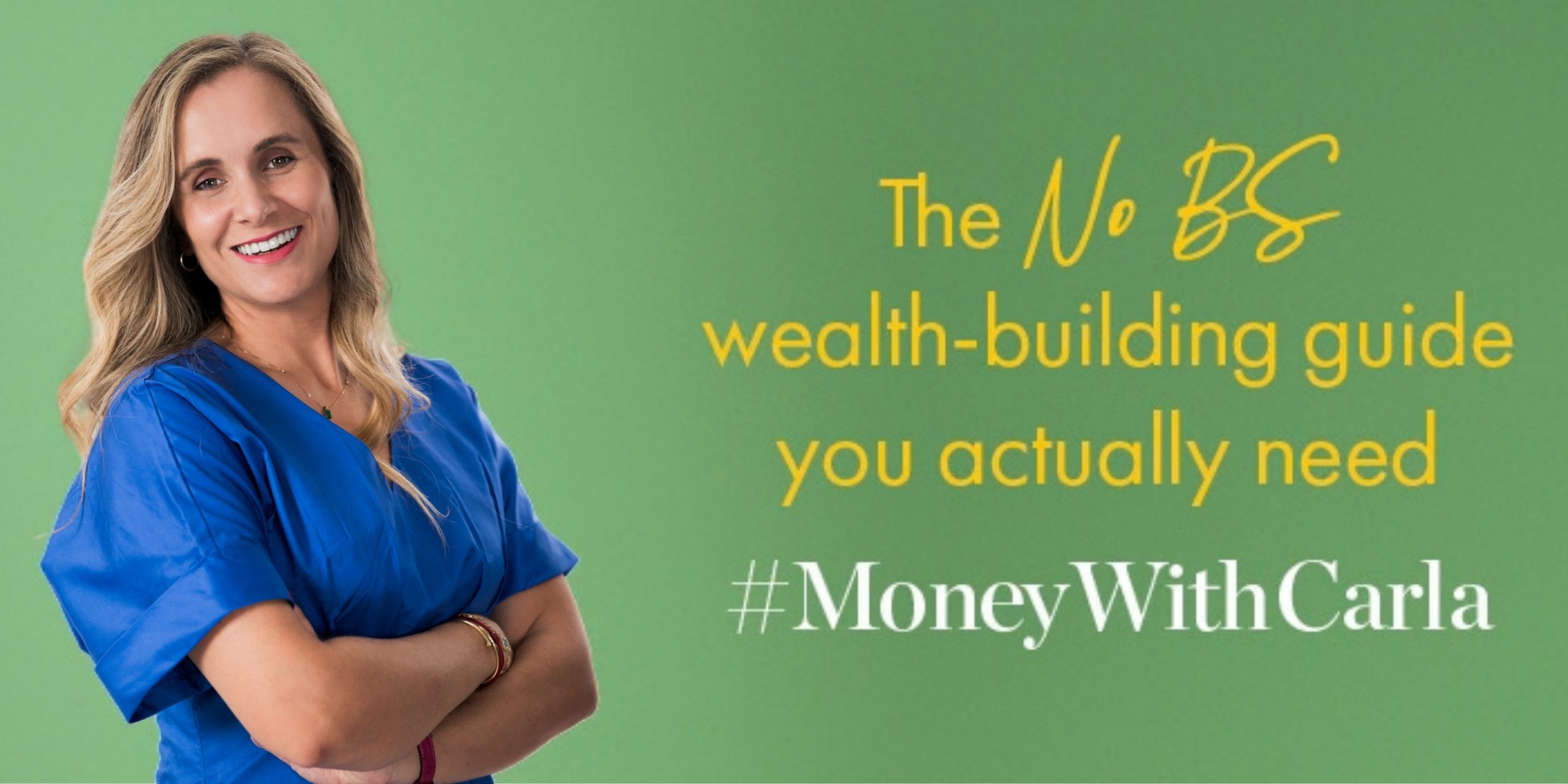
It’s your NO BS guide to building wealth.
Lack of knowledge, or poor money behaviour?
I’ve realised that there are two main categories of reasons that hold people back from building wealth. The first reason is this:
They are committed to living below their means and investing regularly, but they’re investing in the wrong products. I attribute this to a lack of knowledge.
I have many examples of these. Ashley is a 35-year-old physiotherapist who attended a talk I hosted at a Greek restaurant in Cape Town in the early days of Money With Carla. When Ashley’s son was born, she started investing towards his education in a dedicated product sold by her advisor. She’d been diligently investing every month for the past two years. During the talk, she became aware of fees, started looking at her investment reports and realised that the fee on her investment was above 3% all-in, with very poor returns. She had all the right intentions and habits, but she didn’t know any better. (You’ll see later how this fee could mean she loses out on more than a third of her investments’ potential growth.)
The second reason is this:
They might know exactly how to be a smart investor, but they don’t have the best money habits. I call this lack of discipline or running on the ‘treadmill of more’ – in short, poor money behaviour.
For example, Olly, who did his MBA with me in Switzerland and is a qualified chartered accountant and certified financial advisor, has all the right investing knowledge. He now earns a chunky salary in a corporate job in Zürich – more than CHF12 000 a month (that’s more than R240 000 a month). Yes, life in Switzerland is expensive, but as a single man he should easily be able to invest 20% of that salary. He spends all his money on travelling and restaurants: he loves Michelin-star restaurants and taking Tinder meet-up girls on dates (no judgement there). But he knows exactly which investments he should be making and how to avoid unnecessary fees; it’s his money behaviours that are unhealthy.
Lifestyle creep will wreck your finances
In South Africa, I have noticed, there is an unfortunate obsession with ‘looking wealthy’. Social media makes this obsession worse than ever. My grandma and grandpa lived in a tiny town in the Free State called Marquard, which today has a grand population of 15 000 – and you have probably never even heard of it.
Back in the day, in these tiny towns, you’d upgrade your car, and it would be the talk of the town for weeks. You stayed in the same house for 20-plus years. Family holidays were wholesome, and bonding over a campfire was the highlight of the year for us as kids. We barely took any photos. My mom had a camera, and we used to go to the all-in-one pharmacy-type store to develop our photos – hoping that the camera hadn’t been inadvertently exposed to light and ruined the film.
Times have changed completely. Now holiday destinations are picked based on how Instagrammable they are. Photos and videos are taken constantly and shared with friends on social platforms. It feels as if every week someone else is buying a house, getting promoted, getting married or engaged, going on holiday, having kids, buying a new car, running marathons, dressing their kids in the cutest outfits – and you’re doing none of those things.
A new car is not the talk of the town for weeks. The Instagram post or TikTok video becomes stale after a day or as soon as someone else posts something cooler. Instead of comparing yourself to the people in your street or to the parents from your kid’s school, you’re now comparing yourself to people you met once on a beach for a New Year’s Eve party when you were 17 years old, all the ‘friends’ you ever made who now live across the world and some random influencers you have never met. You constantly feel that you’ve been left behind. And even if only subconsciously, you’re comparing your whole life – with all its sad days, arguments with your partner, difficult bosses at work and your disappointing weight gain after a holiday – to thousands of others’ curated highlights fed to you by a very sophisticated algorithm to show others’ most beautiful moments and their successes.
People don’t ask, ‘How comfortable is my house?’ but ‘How big is my house compared to that person’s?’ If there’s one thing you can do that will add tremendous value to your life, it is to focus on your own goals rather than to constantly compare yourself to others.
It’s not about what you earn, but what you keep
There’s the story of Ronald Read, a janitor and petrol-station attendant who drove a second-hand Toyota Yaris and secretly amassed millions in investments on a working-class salary. Everyone, including his family, was surprised when he passed away at the age of 92 with a fortune of $8 million (equivalent to R130 million). No one had suspected in the slightest that he had become a multimillionaire.
He didn’t become one by winning the lottery or inheriting from family. Ronald was the first in his family to finish high school. He did not have an investment degree either and didn’t need one to know that buying blue-chip stocks and sitting on them for decades (to allow for compounding) would make him wealthy. He left $6 million of his fortune to a local library and hospital.
Then there’s the story of two doctors – let’s call them Micheal and Ayanda – who work at Mediclinic Sandton and earn the exact same salary. One, however, is a whole lot wealthier than the other … double the other’s net worth, to be exact. How is that possible?
Micheal and Ayanda both work as ER doctors, earning around R80 000 a month, which comes to a monthly income of R56 000 after tax. They work at the same hospital and receive exactly the same payslip.
Table 3.1 Micheal and Ayanda’s monthly spend comparison
|
Budget item |
Micheal |
Ayanda |
|
Rent
Housing utilities (water, electricity, Wi-Fi, cleaning) |
R14 000 per month two-bedroom apartment in Illovo
R2 500 per month |
R8 500 per month one-bedroom apartment in Illovo
R1 800 per month |
|
Car instalments
Car maintenance provision Fuel |
R10 900 per month 2018 Mercedes-AMG C-Class R1 100 per month R1 000 per month
|
R2 300 per month 2020 Suzuki Swift
R550 per month
|
|
Groceries |
R6 000 per month Woolies only |
R5 000 per month Checkers only |
|
Eating out and takeaways |
R3 000 per month |
R2 000 per month |
|
Alcohol and entertainment |
R2 500 per month |
R1 500 per month |
|
iPhone |
R600 per month iPhone 16 on contract |
R380 per month iPhone 13 on contract |
|
Medical aid |
R2 500 per month |
R2 500 per month |
|
Family support costs |
R3 000 per month |
R3 000 per month |
|
Clothing and personal care |
R2 500 per month |
R2 500 per month |
|
Gym membership |
R1 200 per month Virgin Active Classic |
R400 per month Planet Fitness |
|
TOTALS |
R53 910 per month |
R32 960 per month |
|
Amount left for saving and investing |
R2 090 per month |
R23 040 per month |
So, while Micheal and Ayanda earn exactly the same salaries, Ayanda saves 29% of her gross salary each month, whereas Micheal saves only 3% of his gross salary.
Micheal will certainly look much wealthier than Ayanda: bigger apartment, much nicer car, better phone, fancy gym membership, Woolies food in his fridge.
But their investment accounts tell a completely different story.
* Micheal invests only R2 090 per month.
* Ayanda uses R5 000 per month to build up an emergency fund and invests R18 040 per month.
Let’s assume the following to keep the calculations simple:
* Both earn a 10% annual return on their investments.
* Both receive a 5% salary increase every year and increase their investment contributions by 5%.
* All other lifestyle costs go up by 5% every year too, so that Ayanda does not drive the 2020 Suzuki Swift for the next 25 years.
After 25 years, when they are 60 years old:
* Micheal will have R4.6 million in his investment account.
* Ayanda will have R39.8 million in her investment account – almost 10 times as much as Micheal.
How wealthy you are is not about the salary you earn; it’s about the salary you keep. It’s not about the car you drive; it’s about how much you can control your ego and avoid trying to keep up with those you want to impress.
Extracted from Money with Carla, out now.