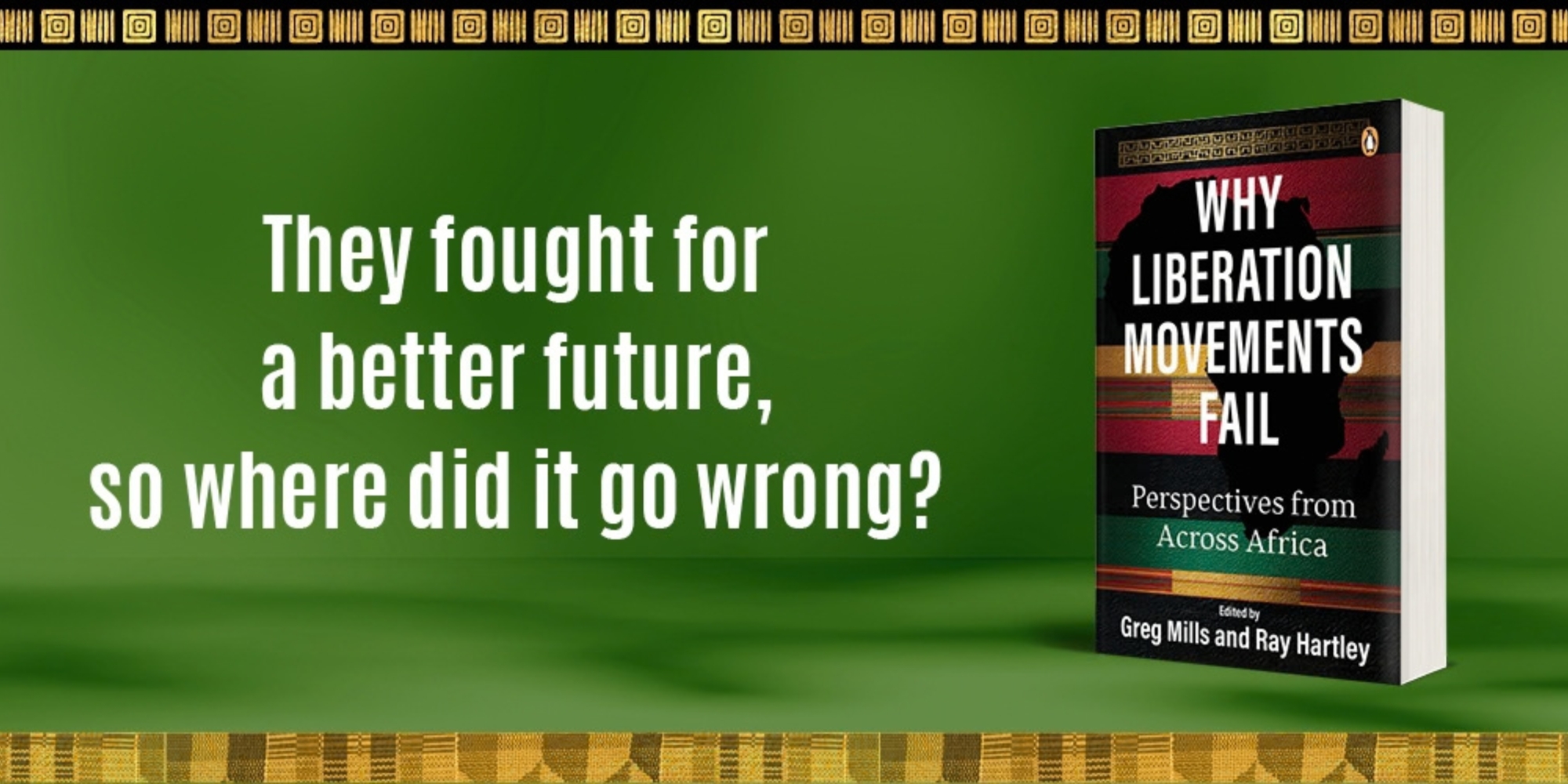
Extract: Why Liberation Movements Fail
In this extract from Greg Mills and Ray Hartley’s Why Liberation Movements Fail, Christopher Clapham examines why movements built for struggle often face profound challenges when liberation gives way to governing.
From Liberation Movement to Government: Legacies and the Challenge of Transition in Africa
Christopher Clapham
The curse of liberation?
Liberation is defined by struggle. Throughout Africa, and indeed in much of the world, there are movements that have fought long and hard, with great heroism and often at great cost, to achieve the liberation of their peoples and their territories from oppressive regimes. These regimes could be external colonialists (for example, Algeria and the former Portuguese territories of Angola, Guinea-Bissau and Mozambique), domestic dictatorships or oligarchies (as in the struggles of the African National Congress in South Africa, the Rwandan Patriotic Front in Rwanda and the Ethiopian People’s Revolutionary Democratic Front in Ethiopia), or governments effectively entrenched in one part of the state territory that sought to impose control over other areas that viewed themselves as distinct and as having the right to separate statehood (as in Eritrea and South Sudan). The length and intensity of these struggles have varied greatly, the most extreme and costly example being the thirty-year independence war in Eritrea. At the other end of the spectrum, there are cases like the Convention People’s Party of Kwame Nkrumah in Ghana, which gained independence entirely by peaceful means but still regarded themselves in key respects as liberation movements. In all cases, however, the consciousness and experience of struggle are critical.[1]
Once liberation has been achieved, and the former liberation movement has assumed power as a national government, the experience of struggle has generally been regarded as an enormously positive legacy for the new state and the regime that rules it. Indeed, the more intense the struggle, the greater the advantages conferred on the new government, in contrast especially to those successor regimes that are often viewed in disparaging terms as having been handed their independence ‘on a plate’.
The now victorious movement inherits from the struggle a powerful sense of legitimacy: these are people who were prepared to sacrifice their lives for the cause, and who have come to power with an abiding memory of the martyrs who died to enable them to rule. They have earned their independence, and with it the right to run the new government. They bring into government, moreover, the ideals that shaped the struggle itself, and which cannot be dismissed as mere window dressing. Struggle, likewise, imposes on those who undergo it the need for purpose and commitment, and the discipline required to maintain cohesion at periods of great stress. Since liberation movements must build their own organisation from the bottom up to compete with powerful and hierarchically organised states, they must, of necessity, look to the grassroots to recruit their fighters and ensure their support from among the ordinary people, on whose behalf they are fighting. And as time goes by, and the immediacy of the struggle fades, its memory or mythology nonetheless remains as a foundational basis for the state and government itself, and an inspiration for future generations. These are all solid advantages that cannot be overlooked.
Nonetheless, virtually all liberation movements have experienced considerable difficulties in making the transition from struggle to government. As the immediate euphoria of liberation subsides – and one needs to be there at that magical moment to understand just how much liberation means to those who have trodden the long road to achieve it – so problems characteristically arise that must be traced back to the liberation movement itself. Few, indeed, are those movements that have succeeded in delivering the aspirations that animated the struggle: aspirations of peace, of democracy, of popular participation in a cohesive national community that delivers welfare to its members. As the problems mount, it becomes all too easy to view the legacies of the struggle not as a blessing but as a curse, and to envy those countries whose transition to majority rule has been marked instead by peace and continuity.
The central purpose of this chapter is to emphasise that the problems of liberation are structural ones, rooted in the experience of struggle and common to virtually every movement of this kind. The experience of struggle is for most of its participants so intense and so specific that it is easy to assume that the difficulties of liberation are the result of circumstances unique to that particular organisation: to its history, to the nature of the territory, or indeed to the personalities of individual leaders and their relationships to one another. Every movement certainly has its own distinctive characteristics, and a range of variance is only to be expected as a result. But what is most striking, across the African continent and well beyond it, is the extent to which similar issues constantly recur. And these similarities, in turn, should foster not a sense of helplessness – that these problems are so entrenched that nothing can be done about them – but rather a sense that much can be learned from the ways in which different movements have tackled them.
Legacies of liberation
Liberation struggles arise under different circumstances and take different forms. To some degree, they leave correspondingly different legacies to the regimes that they form on their eventual succession to power. Insofar as there is a central and common theme that runs through these regimes, however, this lies more than anything else in the mentalities of those who come to power through struggle. This human legacy of struggle is at the same time both strangely difficult to pin down – why do people think in one way rather than another, and why can’t they be induced to think in a different and more ‘constructive’ way? – and extremely difficult to change.
Participation in the struggle is a life-defining experience for most of those who go through it. It changes who you are and how you think. Even long after the struggle has ended, and its former participants have achieved leading positions in government, it remains extraordinarily vivid in the minds of former fighters. It brings with it a deep sense of conviction in the rightness of the cause and the entitlement and responsibility of the survivors to continue to exercise the power and pursue the objectives for which they fought. In the case of bitter and protracted wars of liberation, these survivors carry with them abiding memories of the comrades who perished along the way, and a sense of obligation not to betray those who sacrificed their lives for the cause. One brief example will make the point. The name of Meles Zenawi, the former prime minister of Ethiopia, will be familiar to all of us. But Meles was not his given name: originally called Legesse by his parents, he later adopted ‘Meles’ to perpetuate the memory of a fellow university student who died early in the struggle. What was to others merely a name was to him an abiding reminder of the human cost of victory.
Leaders, especially, are deeply affected by taking their movement through to ultimate triumph and often assume a sense not only of the rightness of their cause but also of their entitlement to the power that follows. Power is not for them the result simply of a popular vote that may be reversed in a later election, still less of a coup d’état that must be justified in some way or another, but it is instead the culmination of a lifetime mission. It is very hard for them to recognise that anyone else could have any equivalent right to rule. For the movement as a whole, its record in the struggle confers – in the minds of former fighters – a virtually permanent claim to state power: those who did not participate in the struggle, including those who were too young to have had any chance of doing so, are expected to take second place to the veterans. This claim may readily trump alternative legitimations for rule, and notably those derived from actual performance in government. It is easy for the movement’s members to assume that the popular support derived from the promise of liberation conveys a permanent and unconditional attachment, and that rival politicians who seek to criticise its performance in office can consequently have no public support and must therefore be suppressed by whatever means the state allows.
That said, the legacies of struggle may be far more ambivalent than its victors assume. One very common problem – and an almost inevitable one, given the arbitrary territorial units imposed on Africa by colonial conquest – is that the war of ‘national liberation’ often takes place in what is actually a non-nation-state. The struggle itself may play an important role in helping to unify subject peoples against an oppressive regime and constitute a vital part of the mythology of national identity. However, victory may well have been won at the cost of suppressing dissidents or rivals, who re-emerge once liberation has been achieved. One common feature of liberation war is the contest for ‘movement hegemony’, during which vicious fighting often takes place between rival movements – as between the Zimbabwe African People’s Union and the Zimbabwe African National Union in Zimbabwe, the Eritrean Liberation Front and the Eritrean People’s Liberation Front in Eritrea, and the Popular Movement for the Liberation of Angola, the National Front for the Liberation of Angola and the National Union for the Total Independence of Angola in Angola – to determine which of them will be the ultimate beneficiary of eventual triumph. They will be established as the ‘real’ embodiment of national identity, as opposed to the ‘divisive’ forces that they have suppressed. Sometimes, divergent factions and rival leaders exist within what is nominally the same organisation. These rivalries, too, often reflect and to some degree represent differences between major population groups. This could be based on ethnicity or religion, for instance, which constitute permanent elements within the national population, so that the victory of one over another comes to be interpreted as bringing one group (not necessarily the largest) to power over others. What is presented from the viewpoint of the winners as ‘national’ liberation may not look that way from the viewpoint of other elements in the population.
There are also considerable differences in the societies in which the liberation war takes place and, correspondingly, in the movements that emerge to fight it. One of the great strengths of liberation movements is that, denied access to the coercive resources of the state that are available to their opponents, they must instead build themselves up from the support that they draw from the oppressed peoples among whom they fight. This provides their fighters with their legitimacy, and the social networks on which they must rely in their long years in the ‘bush’. But in benefiting from these linkages, it is also inevitable that they should become dependent on them to some degree. It cannot be coincidental, for example, that Africa’s strongest and most effective liberation movements have been built within societies that have a long record of governance (however oppressive this may often have been), with entrenched organisational attitudes and values. The Eritrean People’s Liberation Front and the Rwandan Patriotic Front are good examples. Movements derived from pastoralist societies with historically more egalitarian cultures and traditions of deep hostility to settled governance are likely to carry with them the anarchic traditions of their fighters. Here, the different Somali movements directed against the oppressive rule of Mohamed Siad Barre stand out particularly strongly. Once the old regime has been ejected and the former fighters seek to take over the state or establish a new state of their own, the skills and attitudes that they bring to the task may vary enormously.
Further differences arise from the way in which the liberation war itself has been fought. In some cases – and here the Eritrean People’s Liberation Front stands at one extreme – the fighters have carried on the struggle in virtual isolation, locked into the ‘liberated areas’ within their own territory and forced by circumstances to develop attitudes of self-reliance and a set of organisational mechanisms that in many respects replicate the state that they intend to construct after liberation. In others – and Namibia provides an apt example – the struggle is conducted for the most part externally, with a leadership located outside the territory, few if any liberated areas and a high level of dependence on external support. Rather than coming to power with an embryonic state system already in being, these movements are effectively parachuted into office as they return from exile and must largely accept the state structures that they find in place. This, in turn, draws attention to the critical difference between those movements that come to power as the result of outright military victory and those that are able (or obliged) to negotiate a handover with the outgoing regime.
Introduction
[1] This chapter is a personal summary of the discussions at a workshop that brought together a group of participants, including individuals prominent in liberation struggles in their own countries, other observers from those countries, and external scholars and commentators. In accordance with the rules required for frank and critical analysis, the contributions of individual participants cannot be acknowledged by name, and accordingly I can only deeply appreciate the numerous insights incorporated into this chapter that I have derived from them. Equally, in attempting to fashion some more or less coherent narrative from a complex and wide-ranging debate, I must acknowledge the value of contributions that may not have been directly incorporated into the chapter, or that may indeed differ from the views presented here. Participation in the discussion was a thoroughly rewarding experience, and I can only hope that this necessarily generalised summary will be of value, especially to those who find themselves confronting challenges analogous to those considered here.
Extracted from Why Liberation Movements Fail out now.