





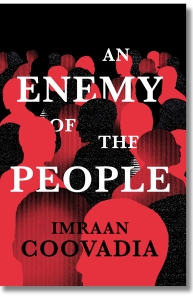
In the sweltering darkness, Mackenjee awakens in a panic, burning his
hands on the carpet, disoriented and searching for his wife, Tejal. A year
of arson and financial ruin has left the city in turmoil. Mackenjee, a tax
collector, pursues stolen billions, while Tejal, a lawyer, defends a young
revolutionary accused of arson and upheaval. As their separate cases
begin to intertwine, the couple navigates a tangled web of politicians,
investigators, activists, and even bakers, all while reckoning with their
own place in a changing Muizenberg, the promise of seaside life, and
the challenge of raising their children.
THE FIREBUG
About guilt, if you spoke about guilt, there was no doubt.
Apollis had hauled three canisters of petrol from the BP garage to the depot in Mowbray, where he led a protest against ticket prices. Seven buses had been torched: Golden Arrows, the grand old ladies of the motorway. Across the region, buses had been held at gunpoint. The drivers beaten. Apollis had led the destruction of books and paintings from the provincial library, followed by the decapitation of colonial statues at the National Gallery.
The evidence was solid. On Facebook Apollis had posted encouraging messages to his followers. His Instagram account showed photographs of him distributing hundreds of Bic lighters. Video clips of his speech in Mowbray appeared on TikTok. Facebook, Instagram, TikTok: the three muses.
The police were treating Apollis with kid gloves. They managed to bring him down to the station without breaking an arm or a leg, which meant someone was interested in his wellbeing. Possibly someone at the very top. At the next party congress, it was rumoured, the president would take note of the recent disturbances. He would then announce the establishment of a people’s transportation service, solving the problem he had created in the first place. Politrickster Number One.
Tejal had been retained as Apollis’s advocate. The request came from the office of Abie Ebrahim, a prominent businessman, who owned newspapers and had been expanding to community radio stations and fish factories. Why was Ebrahim taking an interest in the case?
Apollis … the president … Abdullah Ebrahim … and now Tejal. Mac worried his wife was being drawn into a spider web. He asked to accompany her to the bail hearing. She wasn’t enthusiastic.
‘You can’t just stand up in court and make a point. The way you do in government.’
‘I don’t work for government.’
She put her hand on his hip. ‘I apologise. As a contractor, you assist the authorities in identifying new sources of revenue.’
‘We might not be the most popular, but without us there would be no roads, no electricity, no water.’
But Tejal’s mind was somewhere else.
On Monday Apollis was brought in front of the magistrate. He was tall, young, wore creased cotton trousers and a sweatshirt with a hood, which was printed with Japanese characters. At the magistrate’s instruction, Apollis removed the hood, revealing an open countenance, freckled over the nose. Tired, boyish, thin legs and arms. He could have been the clever nephew who fixed your telephone in two minutes flat.
The room on the third floor of the courthouse had high ceilings and wainscoting. Eight rows of dark wooden benches, like pews in a church, worn down and indented, names and dates scratched into the panels. Left-over grandeur from a different age, when punishment was celebrated.
Some supporters occupied the back of the chamber. They were studying their phones. Through the windows you saw icy rain. It was falling at a slant, more hail and sleet than rain. Everyone’s breath was white. It was freezing indoors, in any public building, between the months of June and August. No money for heating.
Tejal had stayed up late to prepare. She argued for bail without surety, counting through the considerations on her fingers: Apollis was engaged in the community. He belonged to a variety of civic organisations that advocated for the poor. He had been enrolled in graduate study for a decade, and was hoping to start his articles. Some would say his actions should be seen as political, not criminal.
The supporters clucked when Tejal paused. Mac admired his wife from across the courtroom. Her hair was a mass of black and white curls, gathered in a bun, so familiar he could have drawn each strand from memory. She was stouter, spoke slower, but confident. A queen rising benignly over the lesser pieces. Years ago, Tejal had made a different impression. Her expression was, more often than not, of happy mischief. Today she was sedate. Everything flowed and changed its shape.
The magistrate didn’t show much of an interest in Tejal’s presentation. He was more concerned with the cup of tea brought by an attendant, the string revealing that the bag was still in. The magistrate drank and pondered his notes when the presentation finished. He crossed out some of his sentences, looked hopelessly around the courtroom.
After ten minutes the magistrate arrived at a conclusion. Bail was waived. The accused was set free on condition he refrain from further disorderly conduct. That would enable him to make good on his promises of restitution.
The next court date was set for November. Knowing the system, the trial would be postponed and then postponed again. The docket could disappear, taking the evidence with it. In half a year’s time, who would remember the buses?
For Tejal, it was a good outcome. She was a good lawyer. A woman lawyer. A black woman lawyer, if you thought in those terms.
“He was a dancer and a revolutionary. In his fifties, as sinuous as a greyhound, his sleeves rolled up to reveal corded, hairless brown arms.”
For Mac, it wasn’t so simple. People relied on the buses. And what good came of burning books and paintings? The magistrate lacked the strength or conviction to punish. Because of the past, punishment had a bad reputation. The people had never learnt to believe in the law – only fire, burnings, beatings and street executions. Contained within the right punishment was the secret of freedom.
Mac tried to explain his views to Tejal as the courtroom cleared.
‘You’re complaining to the wrong person.’
‘I’m asking how you see your part.’
‘I argued for granting him bail. That’s my part.’ Tejal squared off the documents on the desk, ran her nail along the side, and beckoned to the clerk. ‘It’s a bail hearing. Those are the rules of the game.’
‘What if it isn’t a game?’
Her eyes narrowed. ‘We can save the philosophical discussion for later.’
Mac was quiet while Tejal signed a document for the clerk. Because she had two other cases on the go, she checked for messages from her office. Lawyers were cultists. The right thing needed to be said, in the right manner, at the proper place and time, for the magic to work. Tejal disliked it when Mac veered off in his own direction.
Same was true at work. Mac had consulted to the department for seven years: seven lean years in the country’s history to be followed by seven leaner years. He was good at following money, remaining a contractor rather than being on the payroll. It meant he could do certain kinds of work and talk to certain people, which wouldn’t be possible under Treasury regulations. Everybody was frightened of Treasury.
The Minister had hired him. The man was near to Mac’s heart. But he and Tejal were born sticklers. Stay in your lane. Trust the process. They found fault with Mac when he didn’t share their optimism about rules and procedures.
On the street in front of the court building, Tejal and Mac were stopped by reporters. The newsmen, in blue raincoats, were from the evening edition of the city newspaper, owned by the charlatan who was paying Tejal’s fees. Ebrahim’s spies.
The men set up their lights under the awning, making the two of them wait until everything was ready. They took shots of Tejal, who brushed off the shoulders of her silk blouse, balanced in her wet shoes, and tried to keep her briefcase from getting sodden. The rain seemed to run up the bottom of her trousers in tendrils. The photographer moved around to get a shot from a different angle, the flash coming like lightning. Tejal shook her legs impatiently.
The reporters then moved on to Apollis. He was surrounded by his followers, who were singing and unrolling a red banner on the pavement, untroubled by the rain. They were well trained, freezing for the reporters when they were told.
Ché Govind Subramanian arrived, a red scarf circling his neck and shoulders, accompanied by his small gang of militants and lovers. Ché was the founder of the Institute for Bodily Liberation and a friend of Tejal’s. He was a dancer and a revolutionary. In his fifties, as sinuous as a greyhound, his sleeves rolled up to reveal corded, hairless brown arms.
Ché had visited Apollis in jail. He demanded the prisoner’s release on the grounds that Apollis represented the people. The people couldn’t choose to imprison its own representative. Doubly unconstitutional, according to Ché, when a sergeant used Apollis’s own fingerprint to unlock his telephone and access the incriminating videos.
Revolutionaries and ultra-revolutionaries. Mac looked around and couldn’t help shivering. The rain smoking from the ground. Drenched arsonists and choreographers. The sleeping magistrate. Behind the scenes, the billionaire who sold fish, hake and mussels, dried fruit and newspapers. Comedy gold. If life was a comedy.
In the noise of the downpour the speeches were far away. Now and again, through the rain, came a ringing denunciation of imperialism from Apollis or Ché Subramanian on the megaphone.
The speeches were familiar because the people liked things to be repeated. Golden oldies. What were they denouncing now? The treachery of the English. Their broken promises of financial support. The speakers moved on to the urgency of beheading statues. The necessity of seizing farms for the people. The American embargo: Cuba, Venezuela, Vietnam, Iran. The Americans. Mac avoided looking at the slogans printed on the banner. The gratuitous use of exclamation marks disturbed him.
Between the dark buildings, against the sine wave of the mountain, it was nearly as dim as the closing evening. Cars hissed by in both directions. The occasion struck him as unreal, given the slanting rain and the pedestrians hidden under their umbrellas, averting their eyes from the circus.
Mac’s next meeting was on the Foreshore. He was about to leave when Tejal put a hand on his arm.
‘You want to say hello to the man of the hour?’
‘Not necessary.’
‘You came along to protect me. This is your chance. He doesn’t bite.’
And, besides, Apollis was right there. His hood was down. His collar up. The impression of freshness. His peppercorn hair, cut to within an inch of its life, sparkling with raindrops.
They shook hands firmly. Mac didn’t like having to look up.
‘Keenan Apollis. I am pleased to meet you …’
‘Everybody calls me Mac. An abbreviation of my last name, Mackenjee, as far back as school days.’
‘You don’t have a first name?’
‘I’ve misplaced it over the years.’
“She didn’t generally dislike jokes; she wasn’t a stick-in-the-mud, or they wouldn’t be married in the first place.”
‘Sharp. Mac. It’s Mac.’ Apollis stepped back, as if to get a better look. ‘I have to express my gratitude. Tejal saved my life at the police station. She stopped them in their tracks. Read them the exact wording of the law and made them give my cellphone back.’
‘I didn’t realise.’
‘They had already copied most of the files, unfortunately. Tejal saw the system is trying to frame us. They fear the movement.’
‘I thought you had friends in high places. Don’t they belong to the system?’
Apollis looked surprised. ‘Some people at the top can see what is going on. They are supporters of the movement.’
‘Okay.’
‘As for the others, their response is rooted in their fear of change – and they are ruthless and determined.’ Apollis rested his hand on Mac’s shoulder. ‘I hope you can also get involved.’
Mac would have demurred, but the scene was shifting and the chance to say what was on his mind already gone. Someone slipped another cellphone into Apollis’s hand. He turned away from Mac, pecking at the screen, attended by his well-wishers. They looked at the same cellphone. Small altar, small religion. They had a long day of wrecking ahead of them.
Mac found a place under the awning. His mind was elsewhere in the rain that inhabited the city in its winter months, moving from district to district, never ceasing. The Minister had given him a part in a greater task. They were stopping the country from being stolen. The department was assembling a list of dubious transactions connected to state-owned enterprises: the post office, weapons manufacturers who specialised in radar, artillery and tracked vehicles, the giant railway and electricity corporations.
Vast sums of money were flooding out of their accounts and into overseas banks. From there it was moved to even tinier banks in places like Bangladesh and Malaysia, no more than shop fronts with a telex machine in the back room. There the money vanished. When someone went to find a branch in Dhaka, for example, or Kuala Lumpur, the bank was already closed down and the original owners had moved on.
Was this the biggest robbery in history? Armoured personnel carriers, mining machinery, cultured pearls, the contents of pension funds. Three years of mineral exports: uranium, diamonds and gold, rare earth minerals, lithium for new car batteries.
The raw materials were transported from the mine head in gigantic trains, three kilometres from the first locomotive to the last pig-iron car, shuddering across the Karoo. The containers were unloaded at the ports into Taiwanese and Korean vessels, which shipped the contents to buyers on other continents. The contracts and receipts turned into bank records, receding from one computer to another until, by sleight of hand, there was nothing left but a trail of electrons.
Mac was not optimistic about recovering the lost money. The people on the other end weren’t taking any chances. They would be accumulating Krugerrands, bond certificates, gold coins you could carry around without government being any the wiser. Certain countries had no extradition treaties. Mansions in Dubai built on misery. Who lived under their golden chandeliers?
At the end of the street a long black Mercedes turned and made its way across to their side, its large wheels spinning authoritatively. The car stopped in front of the courthouse. The protestors stepped back to avoid getting splashed.
The driver came around the vehicle and onto the pavement, zipping up his tracksuit with white piping on the shoulders. He produced a large green umbrella from the boot of the car, held it over Apollis, who ducked into the back seat.
Mac watched the Mercedes turn in the direction of the train station. The windows were tinted. How old was Apollis? Twenty-nine, thirty, travelling by limousine. Soviet morality. A leader couldn’t be expected to take the bus. There weren’t any buses. The thought struck him that someone who gave orders could be trusted to obey.
Tejal had come to stand beside him, hands on her hips. The hem of her pants were soaking wet.
‘You see the Mercedes?’
‘No.’
‘Two-million-rand car. Three million if you choose the optional kudu-leather interior. I know the price because of one of my cases.’
She shook her head. ‘Why do I care about that?’
‘It must be Ebrahim’s, is what I am saying. As to the real question, who is playing with whom, who is the cat and who is the mouse, I am not drawing any conclusions.’ He showed her his watch. ‘Your friend Ché Govind Subramanian wants your attention.’
‘You don’t have to say his name like that.’
‘Like what? I’m not making fun of him.’
‘Nobody is responsible for his own name.’
Tejal was almost laughing. She didn’t generally dislike jokes; she wasn’t a stick-in-the-mud, or they wouldn’t be married in the first place. But this was different. Tejal was a lawyer through and through. Which meant, in Mac’s experience, someone in touch with many different parts of life, acting on them in a certain way, bringing them into concert. She saw things out in the world as a series of motions to be decided at the appropriate time. Each piece in its place. But the universe, physics, didn’t allow it.
Extracted from An Enemy of the People, out now.


YOU MAY ALSO ENJOY
Extract: The Poisoners by Imraan Coovadia
The Poisoners is a history of four devastating chapters in the making of the region, seen through the disturbing use of toxins and accusations of poisoning circulated by soldiers, spies, and politicians in Zimbabwe and South Africa.